
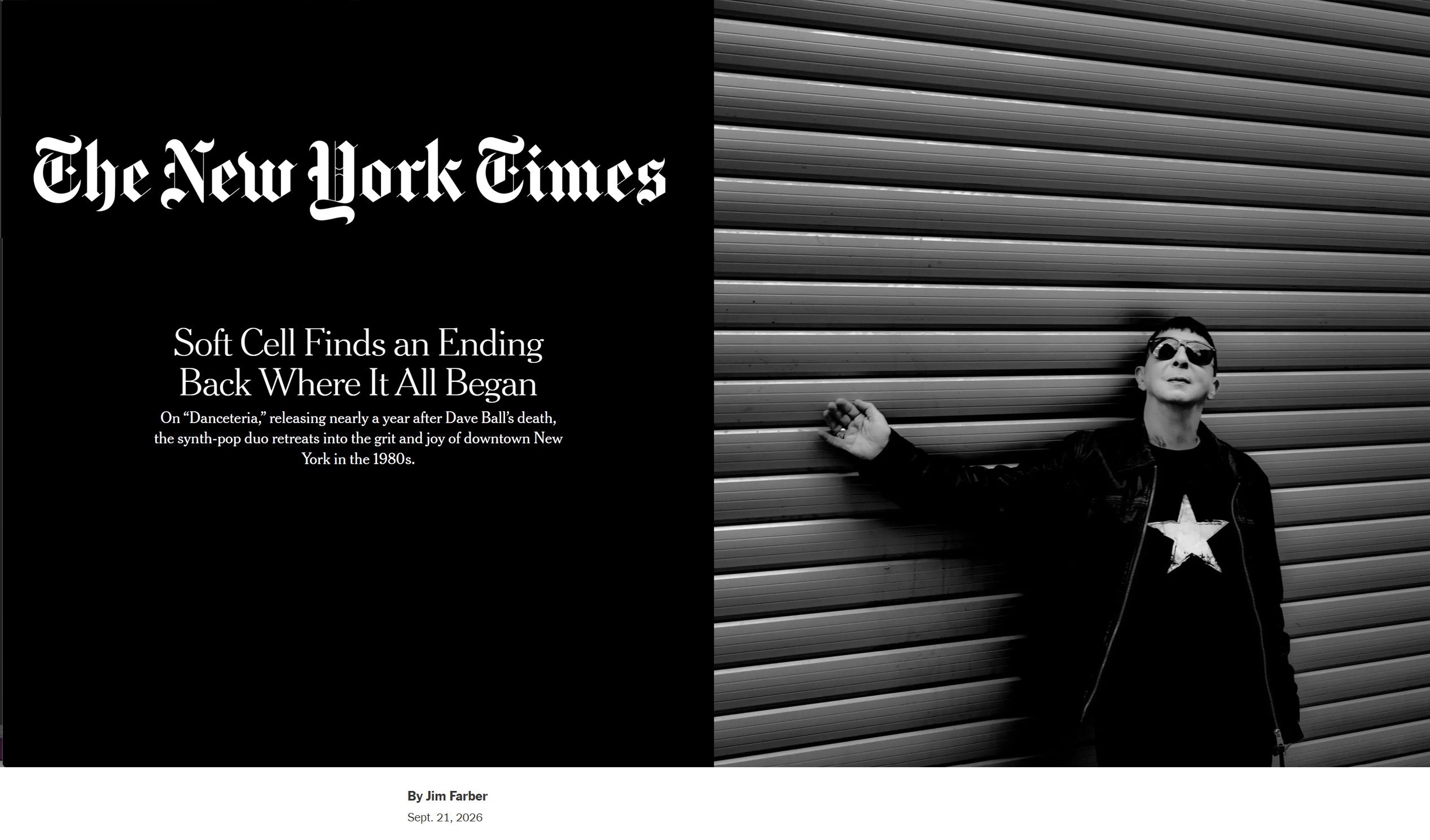
By Jim Farber
Last October, the musicians who comprise the synth-pop group Soft Cell, Marc Almond and Dave Ball, had the chance to hear the final mixes of the album they’d been working on for months. “Afterwards, we were both really happy,” Almond recalled. “Dave was absolutely buoyant. He was even looking forward to doing some dates in the UK the following spring.”
Two days later, Ball was dead, having passed away in his sleep following a cascade of health issues that, over the last decade, included a broken back, pneumonia and sepsis, which exacerbated an ongoing struggle with chronic obstructive pulmonary disease. He was 66.
“Dave had been in bad health for so long that I always thought this album was going to be our last,” Almond said. “Now I know it’s going to be our last.”
A sense of finality may have hung forebodingly over the project, but it also had a less dour effect on the music and lyrics the pair composed. “I wanted to have a different feeling on this record, a feeling of celebration,” Almond, 70, said. “If this was going to be the end, I wanted there to be joy.”
More, he wanted to connect the album back to the music that turbocharged the duo’s career 45 years earlier. In 1981, when Soft Cell released “Tainted Love,” an electronically-charged cover of a ’60s Northern Soul hit, it became a worldwide smash, breaking into the top 10 in America while hitting No. 1 in their native United Kingdom. The impact was so great, it ushered in an entire wave of synth-pop duos, including Eurythmics, Yaz, the Pet Shop Boys and Erasure. It also served as the linchpin of Soft Cell’s debut album, “Non-Stop Erotic Cabaret,” a concept piece that embraced the seedy side of nightlife with so much sincerity, it painted decadence as its own form of redemption.

The new album, out Friday, returns Soft Cell to the club scene, if of an antique breed. Titled “Danceteria” after the storied New York club of the ’80s, it offers what Almond calls “a song cycle with a narrative running through, just as there was on ‘Non-Stop Erotic Cabaret,’” set downtown.
The new album salutes the era’s leather bars, sex clubs, grind houses and, of course, Danceteria itself, complete with shout-outs to famous denizens like Andy Warhol, the performance artist Karen Finley and the D.J. Anita Sarko, a close friend of Almond’s who died in 2015. There’s even a song called “Crackland,” that offers an incongruously joyous salute to the most notorious drug of the era.
The album’s title track arrived one month before the release of a same-named song by Madonna that also salutes Danceteria, one of the first places she played in New York. Speaking of the synchronicity, Almond said, “a lot of us have found ourselves retreating into nostalgia at just this moment because we’re living in such a dark world. The past is where we feel comfortable.”
The distance between then and now was underscored by the setting of our interview, the plush bar of New York’s Soho Grand Hotel, the virtual inverse of the urban grit the album hails. Even so, Almond managed to channel the old downtown energy, talking at a breakneck pace as he underscored his deep connection to the city. “Soft Cell recorded our first three albums here,” he said, “so we became an honorary New York band.”
Image

He and Ball met and formed the band in the late ’70s as art students at Leeds Polytechnic and though they were different in major ways — Almond is gay and outgoing, Ball was straight and introverted — they bonded over a love of confrontational theater, punk and the lurid allure of nightlife. In 1982, when they were ready to publicize their debut work, they held a much-talked about press party at Danceteria that aimed to bring the “Non-Stop Erotic Cabaret” concept to life. For the event the club’s impresario, Jim Fouratt, hired strippers from the Pyramid Club and featured a peep show. Fouratt remembered lots of backsides “swaying back and forth and we had men in see-through jock straps — to my great pleasure!”
Among his original goals for the club was to create a multimedia mix of art, video and music while blending a crowd that spanned sexual orientations and races. It was one of the first downtown clubs in the city to feature rap music, encouraging its fans uptown to come down. “Danceteria was a real bridge between cultures,” said Nona Hendryx, a club regular who has a guest starring role on the new album, a cover of the Was/Not Was song, “The Freaks Come Out at Night.” “This was a place where the freaks really did come out,” she said with a laugh.
The freedom of the era was also shrouded by the earliest reports of AIDS. “On my very first journey to New York in 1981 the first thing I heard on the radio was a report about this new thing they discovered that was attacking homosexuals and Haitians,” Almond recalled. “They called it GRID (Gay Related Immune Deficiency). I just dismissed it.”
Several years later, the fear surrounding sex found a chilling reflection in the lyrics to “Tainted Love.” “It wasn’t a song about AIDS, but the timing turned it into something else,” Almond said.
Its huge commercial success became a case of “too much, too soon” for the duo, who began to crack under the pressure by getting into drugs and acting out. “I mean, we took acid on the Merv Griffin Show,” Almond laughed.
Image

After recording two more albums in as many years, both hits in the U.K. but duds stateside, Soft Cell broke up. Almond began putting out a long string of solo albums while Ball collaborated with other artists. They reunited with the daft idea to record a 2002 comeback album, “Cruelty Without Beauty,” in mono. “The record company said, ‘you’re committing commercial suicide.’ We thought, ‘great!’” Almond laughed.
Though the pair united again, for the “Happiness Not Guaranteed,” album in 2022, Almond considers the overall history of the group fraught. “Soft Cell has never been a very happy place for me,” he said, citing bad management, record company interference and the burden of the group’s legacy as the causes. Ball’s health added stress to their last few years working together. “To be honest, at times I felt I was just doing this for Dave, to keep him going,” Almond said.
When he heard the tracks Ball had sent him for the new album, however, he felt reinspired to make peace with the nostalgic pull of their New York City past. Almond’s favorite song, “Rainbow Room,” is set in the restaurant atop Rockefeller Center where the duo first soaked up the city’s aspirational character. “It captures us looking out the windows toward the World Trade Center, feeling hope for the future,” Almond said. “We didn’t know how much the city would change — and how much we would change, as well.”
One ironic example of the change: Though best known for celebrating the most extreme elements of nightlife, Almond now goes to bed by 10:30 p.m. “The thought of going to a nightclub I find completely abhorrent,” he said. “I don’t have the energy.”
He said he had been recharged after joining fellow ’80s synth-pop mainstays Human League and Alison Moyet on an American tour in June (He played with a guest instrumentalist subbing for Ball) and planned to embark on a solo tour this fall, on which he’ll serve as the keeper of the Soft Cell flame.
“Now I think I’ll probably be imprisoned in Soft Cell forever,” he said, with a laugh. “But, it seems, that’s not such a bad place to be after all.”