
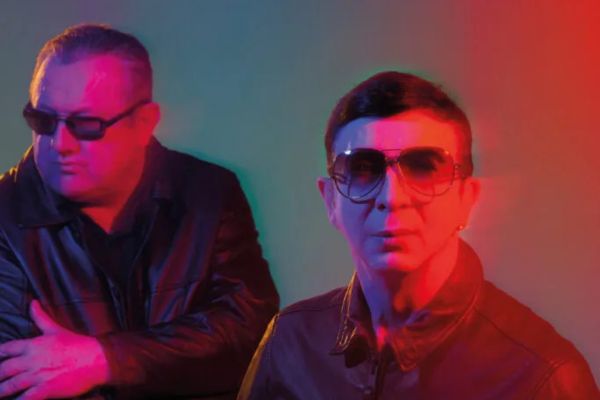

Never tell Marc Almond he can’t do something he’s determined to do.
Earlier this season at the Hollywood Bowl, his group Soft Cell was second on an all-star bill featuring Alison Moyet and the Human League. After an unforgettable set, Marc announced the band’s final song when he was informed they had run out of time. He spent the next three and a half minutes—the length of the song—telling the audience there wasn’t time to play it, then chatted with them some more before thanking just about everyone he could think of.
It was a gangster move.
Weeks later, he recounts the night with characteristic drama and humor. “What a show! What a night!” he says. “On our side of the stage, it was a technical nightmare. The sound kept going off. The visuals kept sticking and jumping. I was having kittens. It’s always been my dream to play the Hollywood Bowl. They are so officious at that place and so union. You should have seen my fury when I got off the stage. But the feedback I got from the audience was great.”
Speaking from his home in Portugal, Marc doesn’t seem bruised from the experience. He’s in a gorgeous room with one turquoise wall, French doors, a tall art deco mirror, and framed artwork above a forest green plush couch with red patterned cushions piled in one corner. Free-standing shelves hold curious knick-knacks.
“This is my room where I do all my stuff,” he says. “It was nothing before, just an attic room and now it’s really nice. We did a lot of work on it. And outside you can see nothing but forests, so that’s really nice as well.”
He wears a New Orleans T-shirt. At first, I think it’s a long-sleeve, until I realize what I took for sleeves are actually tattoos. He’s got short black bangs, burgundy lips, and looks exactly like he’s always looked. He talks with his hands, demonstrating smearing on eyeliner by rubbing his fist back and forth in front of his eyes. His Instagram bio sums him up perfectly: “Tortured Torch singer, Tear Stained ballad crooner, Loveless Rock n Rollin’ Street Walking Cheetah, sometime Soft Cell front man. STAR🌟”
He’s an animated storyteller, which comes through in his lyrics. This is particularly vivid on Soft Cell’s newest, and final, studio album, Danceteria. Named after the famed New York nightclub, Danceteria is an ode to the experiences Marc and his late musical partner Dave Ball had in the city in the ’80s. The album’s final mixes were completed two days before Dave’s death in October 2025, which was two months after his last live experience with Soft Cell.
Danceteria looks back on happier, hedonistic times decades ago. But to hear Marc sing about it and talk about it, it feels like no time has passed at all. Madonna’s Confessions II hitting No. 1 in more than 20 countries the week before our conversation, with a song titled “Danceteria” on it, certainly doesn’t hurt Soft Cell. He namechecks her on the title track, recalling the night he saw her perform at Danceteria.
“When we announced our album over a year ago, we didn’t think there was anybody else doing a track called ‘Danceteria,’” says Marc. “That was the first thing that came into my head when we started working on the album. I had the club in my mind, but also, it’s just such a nice word. Dance sees us through different stages of our lives, so we live in this big danceteria. I wanted the album to reference that time. [Madonna’s] ‘Danceteria’ might crush us a bit in the algorithms, but it’s all cool. Maybe we can get some algorithms from her algorithms.”

At the time, wasn’t it unusual for a British band to come to New York to record their first album?
What happened was, we’d had this big hit with “Tainted Love” in the U.K., and the obvious thing was to record the whole album, which was Non-Stop Erotic Cabaret, with the producer, Mike Thorne. We wrote mostly around London and there was a narrative through the album. Mike said, “I don’t want to record an album in London. I think it would be great for Soft Cell to come out to New York. We’ve got a great studio there, Mediasound.” People like T. Rex and Jimi Hendrix had recorded there. It was an adventure for us. We ended up doing the next [remix] album there with him, and the next album.
It was really our liberation because we had the record company down on us, watching, trying to manipulate everything we were doing. We were two belligerent art students who’d had five years of art college doing transgressive art, really confrontational stuff, punk stuff, things like that. We thought we were in this weird world of the pop industry where people are trying to conform you and tell you what to do and what to record and how to do your records.
We were cool with Mike. We really liked him. To go to New York was like a godsend for us because we were away from the record company, which means we could actually start to be ourselves a bit more and to discover ourselves as a duo, as people. It was a growing up experience for us because though we’d experienced London, we’d experienced art college, we hadn’t experienced anything until we came to New York in the early ’80s.
It was a creative time. There was the hub of the downtown art scene and the performance art scene. DJs were coming up and music was reverberating around everything. But New York was a dangerous place at that time, dilapidated, falling down. I took a taxi home one night from an afterhours club, and the taxi driver collapsed over the wheel and crashed into the wall. I had to make my way home with bonfires in the street. You know what 42nd Street and Eighth Avenue was like around at that time. I got robbed and fleeced. They were gangsters.
I went to Studio 54 on my first week there. It was the dying days of Studio 54, I should say, but it was Studio 54. There was still the guy with the coke spoon. I got my drink spiked and I was dancing to Sylvester’s “You Make Me Feel (Mighty Real)” and then ended up sitting on the curb outside, crying my eyes out, being comforted by two girls who became great friends of mine. They saw me through all this chaotic time of over-culture and over-sensory overload in New York. But I just loved it. I found myself. Both Soft Cell-ers, we found ourselves there. It felt fitting that our last Soft Cell album take that round full circle, come back to the beginning, and do a love letter to that time.
How amazing to have creative freedom so early on in your career.
We were pretty much well behaved over Non-Stop Erotic Cabaret. We discovered this new drug called ecstasy that was doing the rounds for the first time. We were exploring the nightlife and the city, but we still managed to make an album that the record company were pretty happy with.
It was when we started on the next album, The Art of Falling Apart, that we ignored all calls from the record company and said, “Let’s make an album you want to make.” I put it into the hands of Dave and said, “You make the album that you want to make. I’ll write the lyrics. I’ll sing it. I’ll put in my influences. But this is going to be an album about what you want to do musically, and the influences that you put into it.” Dave had a lot of dark influences that went into that album. The record company were not very happy when they heard it, and Mike Thorne wasn’t happy either. He later said he thought it was a nihilistic album that was committing commercial suicide. It was meant to be a deliberate attempt to commit commercial suicide to have a legacy that would maybe get a following that would last with you, as opposed to being a disposable pop act, which the record company really wanted to change us into.
When I look back at it now, I think I was lucky to have that time. Record companies are just record companies. They always want you to make money, to do the commercial thing. When we gave them an album with basically no singles on it—the one track we recorded at that time, a song called “Torch,” became No. 2 in the charts. It was actually No. 1 in the mid-weeks, but we didn’t put it on the album, which was a crazy thing to do really. That’s how we were. We were having this battle against the establishment. That’s what we called the record company. We weren’t the first to do that.

What a bold move to intentionally go against what had worked for you commercially.
It was important. We’d already had a succession of big hits from Non-Stop Erotic Cabaret: “Say Hello, Wave Goodbye,” “Bedsitter,” so we’d got that fanbase. I had young girls screaming at me at concerts and people were writing me letters. This was really weird for me. At the time, a song like “Bedsitter” hit home with people because people were living this mundane life in the daytime, in their bedrooms, then at nighttime, they were going out and being themselves. People identified with that. They saw me on the TV and saw that I wasn’t the usual pretty normal pop star. The record company were always saying to me, “Don’t wear that. Don’t put on that eyeliner. Tone it down” So I’d be putting on the eyeliner even thicker, wearing studded bracelets and things. I went on the TV as gay and as out there and as camp and as queer as possible. They saw their future statements going down the drain, and so did we. But it was important for us to do that, and to try and make some sort of subversive statement.
It worked out in the long run.
Yeah, absolutely. We got ourselves a real loyal base of fans, and in America as well. Probably mostly first on the West Coast, and we had a New York following. But as time goes on, it’s spread out a lot more. I put that down to this obsession people had with the ’80s—and that they still have—which is fine because that’s great for me. I also think people are discovering through different music medias that you have now. They’re discovering a lot more music. They’re discovering music that maybe their parents listened to. They’re reliving those times because we’re all retreating into nostalgia these days because it’s such a comforting place to be, so the Soft Cell thing has grown bigger and bigger.
It’s always good to celebrate without reveling in saccharine nostalgia. A lot of us retreat into nostalgia these days because the world is in such a messy place that we have to find comfort in the past. But you’ve always got to move forward as well. Talk about big strong female artists doing the same titles as your songs—the last album, *Happiness Not Included, the original title was Future Nostalgia. We were just about to launch it, and Dua Lipa came along and called her album Future Nostalgia. I could have died through the floor with that. I got this thing with these strong female artists. I must be in their zeitgeist or something.
When I do concerts now, I see a varied audience. A lot of the older people come because they grew up with the music, and the younger people because they hooked onto the music later, or they listened to their parents’ records, or it’s influenced bands they like and they come along to see the roots of it. The tribes of music have gone away and we listen to everything. I go to my friend’s Spotify and they’ll have everything from the ’80s or the ’70s or even the 1930s and ’40s. A mix through all kinds of music and I really like that.
But I’m 70 next year. How much time have I got to listen to new music? I like listening to music I’ve always liked and always loved, and sometimes somebody new will come into the mix. I’ll discover them and I’ll love them. But I don’t go out looking for it. I don’t listen to loads of new music because most of it is kind of similar to what I’ve grown up with or a version of it.
How are you coping with the loss of Dave?
This third stage of Soft Cell—we split and come back together again on two occasions—has a poignancy and sadness because I’m enjoying it more than ever. Two days before Dave died, we both listened to the album for the first time. He said, “I’m really happy with the album. Are you happy with it?” I said, “I’m really happy with it. I think it’s better than the last one. I think it’s one of the better ones we’ve done. Now let’s enjoy it. Let’s do some dates.” He goes, “Yeah, let’s go for it.” Even though his health was terrible, he really wanted to do some dates and go out and live the life of this album. I did a show with him a few weeks before he died. He could never do shows outside the U.K. He was eventually confined to a motorized wheelchair, so he had a lot of trouble when he had to do gigs. He looked in very bad shape. He was very ill. I wasn’t happy with him being on the stage because I didn’t want people to see him looking bad. But it’s his group. He’s got a right to be there. When I heard the news about him, it wasn’t such an awful surprise. But I felt shocked. I felt sad. I felt it was bad timing. I wanted him to enjoy the life of this record, whether it’s a week, two weeks, or two months, or a year, or whatever.
You did an interview with Simon Price for the Quietus in 2015 where you said you didn’t know if you’d ever work with Dave again. But you also said you never say “never” to anything.
Well it’s been a long illness with Dave. We nearly lost him a couple of years ago when he had a very bad fall and nearly broke his back, which confined him to a motorized wheelchair. Within six months, I got a call from the manager who said, “Dave’s done a load of new songs. Would you like to listen to them? And if you like them, would you write something to them? Even if it’s just for solo stuff.” When we work together, it’s Soft Cell. But with Soft Cell comes a whole load of baggage as well. The minute I put his tunes on, I loved them instantly and I instantly started writing ideas. He died at the end of last year. The music has to go on. It’s a cliché, but they say the music lives on. I want to see this album have a good life. There will never be another Soft Cell song unless Dave’s at the heart of it. I will never write a Soft Cell song with anybody else.
I’m 70 next year. I think every album you make is possibly your last album, so you’ve got to put the love into it. I don’t know how long my recording career is going to last. I’ve got a couple of albums planned. I’ve just done an album with Barry Adamson. That’s my next solo album. I work with a writer/producer, Chris Braide, as well. Do I really want to do any more recording after that? I’m not sure I do, to be quite honest with you, but I always love playing live. Wheel me on in a Zimmer frame or a wheelchair. It’s amazing that Dave and I both didn’t end up coming in wheelchairs because my knees are not what they used to be.
You’ve had your share of health issues and brushes with mortality. Both of you were in comas. Did that give you a different perspective on life?
It does. I’d been through problems before. I’d had drug problems. I’ve been in rehab, out in rehab, blah blah blah. But the motorbike crash, where I was very badly injured, I was lucky to have come round and lucky to have recovered. I was very belligerent about it. After being in a coma for a few weeks in a hospital bed, in bandages and head injuries and broken shoulders and everything, I was determined from that moment that I was going to get out of that bed. I went on TV to do some interviews to say I’m still alive. I had my head shaved because I’d had surgery on my head. I went down to about seven stone. I looked sick. I look back at those interviews now and I put my head in my hands. It’s so painful to watch. I look so terrible. I sound like I’m talking complete nonsense. But for me, I had to get out there and do it. I was euphoric that I was still alive.
I was brought on stage by what used to be Antony and the Johnsons for the first time. Between Anohni and Jools Holland, I toured with him as well, they brought me back on stage and gave me a stage life again. I’m very grateful to both those people.
I had to find my voice again and to find my confidence again. I have memory problems from head injuries, so I tend to use auto prompt a lot more than I used to. So many songs, so little time. I have my stage comforts to help me get through sometimes. But I’m enjoying myself in music more than I ever have done in the past. I’ve come to relax within myself a lot more. The time in front of you is shorter than the time behind you. You’ve got to celebrate all the moments.
When I got to 60, it was great because you can say what you want and do what you want and wear what you want, and everyone just thinks you’re some crazy old person. You have this sense of freedom. I found that freedom later in life. I do what I like to do and what makes me happy and I enjoy myself in music and performance more than I have done for a long time.
Coming from the fan side, you would never know you didn’t have confidence. Your performances give me confidence.
I didn’t always have a lot of confidence. I had stage fright and stage worry. I had nightmares that I’m about to go on stage and hadn’t learned any of the songs at all. You find your ways of getting through it. You go on stage and you become somebody else anyway. It’s like this thing takes over you. Now, I can walk on stage and whether it’s six or 20,000 people, I always say—I stole this saying from somebody else—”I love being on stage so much that I act like I am even when I’m not.” I’m dramatic all the time.
I’m getting the impression the queer community is getting splintered. What’s your view on that?
I feel that a lot. It’s splintered into little groups. That’s a real shame. It took me a while to embrace the queer term, which is the new gay term. When I was young, if you were called that, it was usually followed by a punch in the face. For people of my old school gay generation, it was a weird thing to hear. But I get it now. It embraces people who felt an outsider in society, in life, in the world. They feel a little bit tilted, a little bit off the edge of everything else. And I think that’s a great thing. People have called me all sorts of things in my life. As long as it’s said in a friendly way, I don’t really care. People say, “Oh, you’re a queer icon.” Well, that’s great. I embrace anyone that calls me an icon for any reason. I’m happy to be that. But it’s a shame that things are quite splintered in the gay community. There’s too many factions. I feel sometimes there’s too many different colors on the flag. It should encompass everybody as one thing, and I think, in a way, the queer thing does do that to an extent. It encompasses all people that have felt marginalized or outsiders or not felt that they’re quite in tune with the rest of the world.

You were appointed an Officer of the Order of the British Empire. Did you ever think something like that would happen?
That was a real big shock to me because I would have never expected it. On the list of honors to get, an OBE is quite a high honor. My friends campaigned for that behind my back for a long time. I kind of paid my dues in the hard work field, but it was just an amazing thing to happen to someone like me. I liked it especially because my mum was so happy. To take my mum to Buckingham Palace, my friend loaned me a big black Daimler car. He said, “I’ll lend you my car with my doorman, who can be your chauffeur.” So we drove into the gates of the palace with my mother and my sister. It was snowing at the time so it was very dramatic. For them to experience this was a fantastic thing. It wasn’t just for me, it was for other people as well. I don’t often use it, but sometimes in a hotel, I’ll put “Marc Almond OBE” because it might give me an upgrade.
What’s left on your bucket list?
I just take life as it comes now. I don’t plan too much. The Hollywood Bowl was on the bucket list as a venue I’d love to play. I’d never seen Niagara Falls, and I saw that on the last tour. There’s always something. I love traveling. I love to see different places. I’ve never been to India, and I would love to go. I’d like to go to Kathmandu. But careerwise, I’ve been really lucky. I’ve had nearly a 50-year career, and I have to thank that almost down to one song which is “Tainted Love.” That two-and-a-half-minute song opened so many doors. When I was touring America a few weeks ago, I heard it on the radio almost every single day. I get in a taxicab and I hear it. I saw it in a movie. It’s on the soundtrack. On an advert. It’s just everywhere. Nothing has had a life like that record, but it’s given me an amazing life. When people say, “Are you sick of doing that song?” I say, “No, never.” You’ve always got to do it because if you do that song, it will forgive you everything else that you’ve done. You can play a set of all your darkest songs and then you play “Tainted Love,” and everybody loves you.