
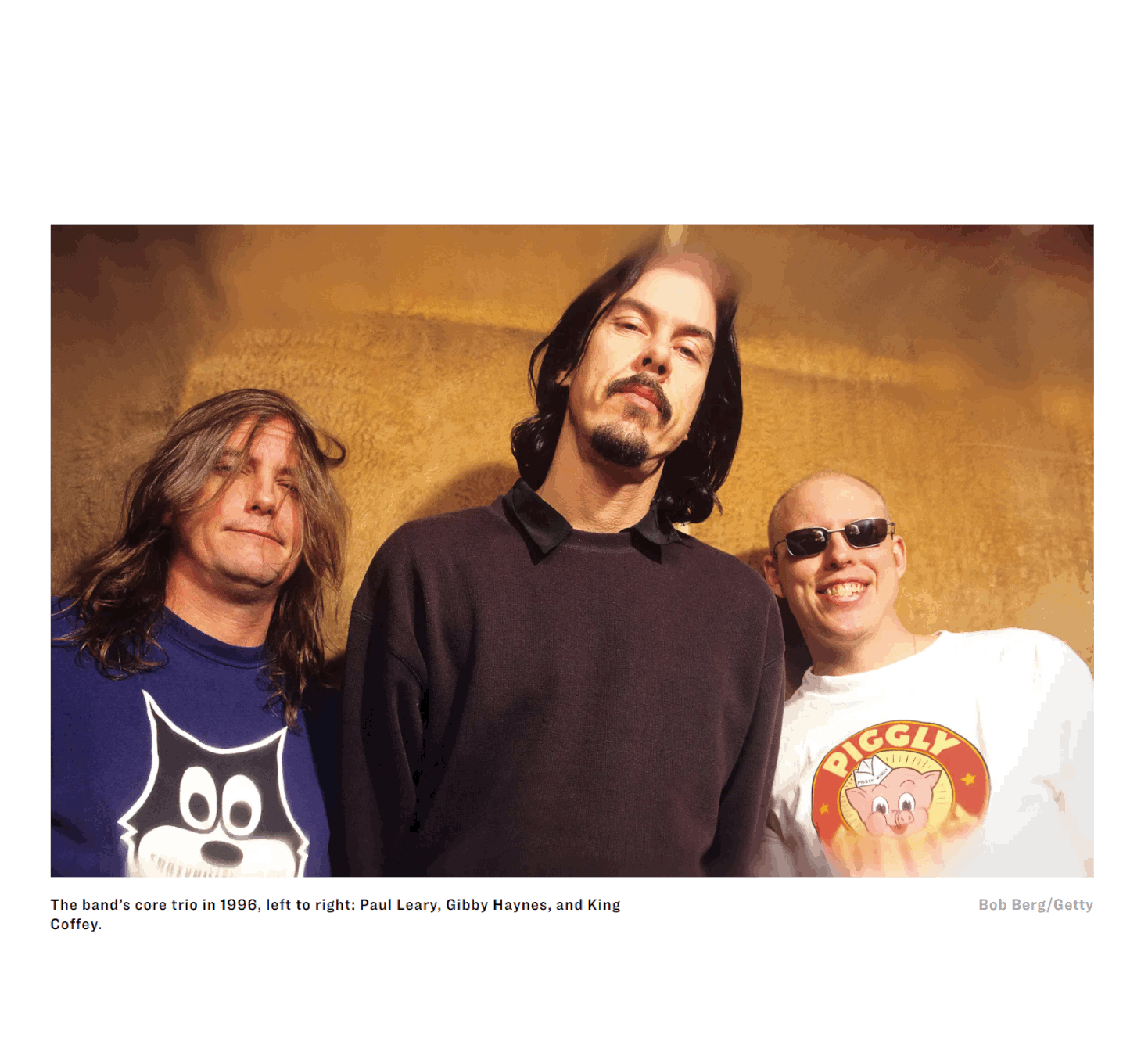

Austin’s Butthole Surfers weren’t just iconic, they were iconoclastic. There were the unhinged live shows—not so much concerts as performance art, in which front man Gibby Haynes would strip to his underwear, or fire a shotgun, or set a cymbal on fire, or hide condoms filled with fake blood under his clothes and then fall mid-song and appear to bleed all over the stage. Drummer King Coffey preferred to play while standing up, and guitarist Paul Leary would cross his eyes and drool through his set. Punk rock luminaries like Jello Biafra and Kurt Cobain adored them. They were literally named “Butthole Surfers,” a provocation intended to make it impossible for radio to play their records or magazines like this one to print their name.
“Were,” because one day, during a session for the band’s 2001 album, Weird Revolution, Coffey had a realization about what his group had become. He was recording “The Shame of Life,” a track improbably cowritten by Kid Rock. “I was playing backing tambourine on a Kid Rock song,” he recalls. “And I realized, ‘What the f— has happened here?’ How did we go from being the Butthole Surfers to this, to being a Kid Rock sideman?”
Coffey and Leary are at breakfast with me at a Mexican restaurant in the Austin neighborhood where they both live. It’s been decades since Weird Revolution—until recently thought to be their final album. But the shame of “The Shame of Life” is still on their minds, thanks to an unexpected twist in the Butthole Surfers story.
Much of that story is a classic rock and roll tragedy, like the plot of Wayne’s World: College students (Leary and Haynes) meet at Trinity University in 1977, start a band, recruit a superfan (Coffey) to play drums. They move to Austin, become part of the national hardcore punk scene. The nineties and Nirvana come around, and suddenly, major labels rediscover punk rock and throw money at it. In 1991 the Buttholes sign a deal with Capitol Records and score a hit single with “Pepper,” off their 1996 album, Electriclarryland. But now it’s 1998. Tastes have changed. The band records After the Astronaut; Capitol Records doesn’t like it. The label “refused to put out the record, but it also refused to let us go out of contract, which meant that we couldn’t release anything at all. We were stuck,” Coffey says. Salvation seems to arrive in the form of Hollywood Records, hot off a hit with another Texas band, Austin’s Fastball. Hollywood takes over the Buttholes’ contract and decides to “polish up” After the Astronaut, as Coffey tells it. It gets a new name, as the label tries to “scrap songs it didn’t care for and put in songs that would hopefully help sell the record.” As salvation goes, it’s sort of mixed. “Basically, we were told, ‘Go write “Pepper” again.’ ”
Thus they ended up in the studio with Kid Rock, transforming an album they were proud of into one they weren’t, recording a song featuring a chorus the chart-topping rap-metal superstar had written: “I love the girls and the money and the shame of life.” (“That was before he was MAGA and all that crap,” Leary notes. “Otherwise we wouldn’t have done it.”) The band struggled under the label’s constraints, but Weird Revolution eventually emerged from Astronaut. “It certainly wasn’t fun,” Coffey says. “It was a drag, as we thought, for our last album to end on such a terrible, dismal, corporate note.”
Weird Revolution didn’t sell, and for the past 25 years, Butthole Surfers have released no new music, touring only sporadically, making the odd festival appearance. But then that twist: Not long ago, the band got the rights to its scrapped album back.
That album was finally, officially released on the band’s terms on June 26, as After the Astronaut. It comes during a broader reexamination of the group and its legacy. “Pepper” is back on college radio, owing to a new cover by Americana darling S. G. Goodman; a documentary about the band, Butthole Surfers: The Hole Truth and Nothing Butt, which premiered at SXSW in 2025, is slated for wide release via Austin-based Alamo Drafthouse in late August; and this spring, San Antonio Congressman Joaquin Castro nominated the band’s eponymous 1983 debut EP for enshrinement in the Library of Congress’s National Recording Registry, alongside contributions from Beyoncé and Selena. This all came shortly after the band’s song “Human Cannonball” was used as a prominent needle drop, followed by an on-screen discussion, in the penultimate episode of Stranger Things. Are we experiencing Hot Butthole Summer?
The last Butthole Summer came when “Pepper” blew up, in 1996. Haynes and Leary were both pushing forty; Coffey, who’d joined the band late, was in his early thirties. Alternative rock was ascendant. Gin Blossoms, Goo Goo Dolls, and Joan Osborne all had top-10 hits, and Butthole Surfers landed a single at number 26 on the Hot 100. Fans who’d gravitated to their anarchic live shows were outraged. It was an era when the epithet “sellout” stung, as the previously underground punk/hardcore/emo/alternative scenes were raided by major record labels eager to find the next Nirvana. The band dismissed the allegation at the time and still does.
“It always aggravated me to hear people talk about selling out. Back in those days, people were only happy with you if you were destined to die in poverty. You shouldn’t wish that on somebody you like,” Leary says. In the band’s early days, realizing that the projectors and strobe lights used for their live shows were expensive to haul around, they began charging $8 for tickets rather than the customary $5. “I remember some girl from a fanzine asking me, ‘How do you feel charging all this money to the poor punk rockers? Aren’t you ashamed that—’ And I was like, ‘You’re going to go home and sleep in a bed tonight, and I’m going to f—ing sleep next to some stranger’s cat box.’ ”
“The whole selling out thing never really applied to the Buttholes, because we were making music we wanted to,” Coffey agrees. “Until Weird Revolution.” He gets reflective. Working on that album, “we realized the only way we can have a recording career is if we work with the label and try to get them songs they want so they can put the record out. And then I’m playing tambourine on the f—ing Kid Rock song, and that was just selling out. It never occurred to me until now.” He sighs like he’s just had a breakthrough in therapy.
The original sellout allegations hinged on “Pepper,” which sounded more like hits from other hot acts of the mid-nineties (think Beck, or maybe Cake) than the band’s punk roots. Coffey’s Weird Revolution realization puts the turning point a few years later, which makes After the Astronaut so much sweeter: Finally, the band is in control of the material it initially recorded for that album. The way that came about is unusual, even for Butthole Surfers. A few years ago, Leary found the two-inch multitrack tapes they’d recorded for the version of After the Astronaut that got scrapped by Hollywood Records. He contacted the label, reached someone he’d never worked with before, and asked whether the band could have the record back and release it on their own.
“To their credit, they said it was okay,” Leary says. “They gave us official written permission because they technically owned it. I think they knew there was no money to be made on it.” The band members put some work into tuning the recovered album, but they didn’t expect After the Astronaut to generate any sort of windfall. Their desire to get it out goes beyond the commercial.
“It’s something that we want to see happen because we like the music,” Coffey says. The original sessions felt “like going back to our experimental roots in a way—we were playing around with new toys, samplers. Computers. And doing stuff we’d never done before. We like that there’s one particular forbidden album, in a way, that’s finally seeing the light of day.”
Butthole Surfers may never again play live, write, or record music together. Leary’s fine with that. They played a few songs, probably for the last time, at a screening of the documentary last year. “It was fun to work with the band for three songs, but I’m old and out of shape,” he says. “I’d be shocked if we play anymore.” He goes on a brief rant about aging rock stars, calling out AC/DC and the Rolling Stones for touring as old men. (He makes an exception for ZZ Top: “Those guys could play until they’re one hundred and twenty and they’re still cool.”) It’s one of several breakfast rants—he’s annoyed by fans offended by his use of generative AI to create the cover of an archival live album the group released last year. (“People would say I put a graphic artist out of work by doing that, but I’m the graphic artist. I spent ten minutes drawing the cover for PCPPEP with a ballpoint pen on typing paper.”) Leary might be wary of continuing to perform, but it’s perhaps notable that the art for After the Astronaut features his hand-drawn illustrations, including a drawing he made as a child on the back cover.
I asked Tom Stern, who directed The Hole Truth and Nothing Butt, what it means to see the band reclaim the bleakest part of its discography. “It’s not often in life that you get a do-over,” he told me. “And for Paul, especially, I think it was a labor of love to set the record straight, and put out a record that they could be proud of.” He doesn’t expect the band to tour again, but he remains hopeful that it might record again—it did so for a scene in the film, laying down a cover of Scottish folk singer Donovan’s 1968 psychedelic hit “Atlantis.” “I think they had fun,” Stern said, adding that he wouldn’t be shocked to learn of new material in the future, even if none has materialized in the years since the session he filmed.

Even if After the Astronaut is the band’s bid to close out its career on its own terms, the Buttholeaissance is at hand. The group’s discography may not have accrued “a billion listens, but it was pivotal in the development of other music. [That’s why] we put Butthole Surfers in there,” said Joaquin Castro when I asked him about including the band’s debut on his list of submissions to the National Recording Registry. “It was trailblazing music [for] experimental rock and punk.”
The public reexamination of the band’s career has surprised its core trio. (Others have joined and left the group over the years; Jeff Pinkus, a bassist, is the Buttholes’ fourth-longest-tenured member.) In May, S. G. Goodman taped her first appearance on Austin City Limits and played her cover of “Pepper.” Introducing the song, she explained that she was seven years old when it hit and was suddenly, to her delight, allowed to say the word “butthole.” The Gen X–ers in the crowd sang every lyric back to her; it seemed like even the fans who once called the band a sellout still had some affection for the song. “When ‘Pepper’ came out and became a hit, it seemed to aggravate a lot of our old fan base. We didn’t feel a lot of love for that success,” Leary says. “Thirty years later, we’re feeling the love for that success. That’s been really gratifying. People didn’t forget.”
Leary talks about his Surfers years like they made up a tour of duty. When I ask him whether he thinks of the band as something he occasionally does or something he is, he demurs. “I don’t really think about it a whole lot.” He rides his bike and goes to the supermarket, he tells me. “That’s my social life, and that’s it. I’m probably better known as a producer for Sublime than Butthole Surfers.” When I ask him how it feels to see After the Astronaut finally come out, he acknowledges that it “satisfies an itch” he’s had for a long time but adds, quickly, “I’m just really glad that it’s finally over with.”
For Coffey, though, the band looms larger. “Paul has had a diverse life,” he says. “I haven’t. I joined the band when I was seventeen. I’m sixty-two now. The Butthole Surfers took a big chunk of my life.” (At this, Leary chimes in with a “Sorry, King.”) Coffey looks back on the heyday as “a blast.” He’s proud of the group and sees it as a reflection of the American hardcore punk scene of the eighties, particularly as it existed in Texas. “We were inspired by our hometown heroes like Big Boys and the Dicks, and also bands like Scratch Acid and the entire Austin music scene,” he says. “I think we were one of the shinier examples of that era because we kept putting out records. But there were a ton of great bands back then. We were just part of the scene.” He’s surprised that, say, the Meat Puppets—also psych punks turned alt-rockers with ties to Texas—don’t have a documentary about them yet.
I don’t get the sense that Coffey’s humility is an act. And while it’s often hard to tell whether Leary is playing the role of a curmudgeon, there are other moments in which his sincerity is clear. When I ask him about all of the things the band has been to different people over the years—an art project, a chance to live a dream, a major-label sellout, a subject for a film, an asset on a corporate balance sheet—he mostly sounds pleased that it got to be anything at all. “I’m just glad it’s something to somebody,” he says. “We could have been forgotten like every other band. None of it ever made sense to me.” That another Butthole Summer is upon us makes little sense too—but there’s a lot about the band worth remembering.