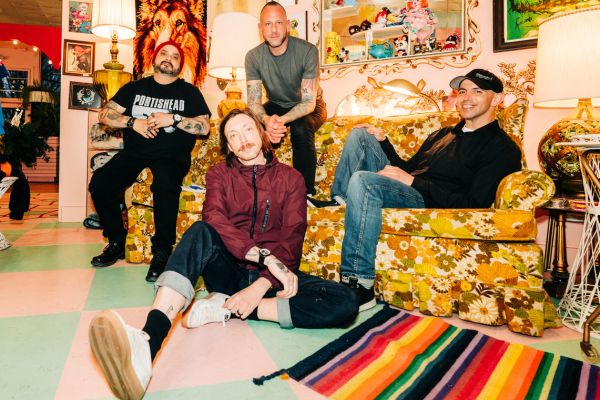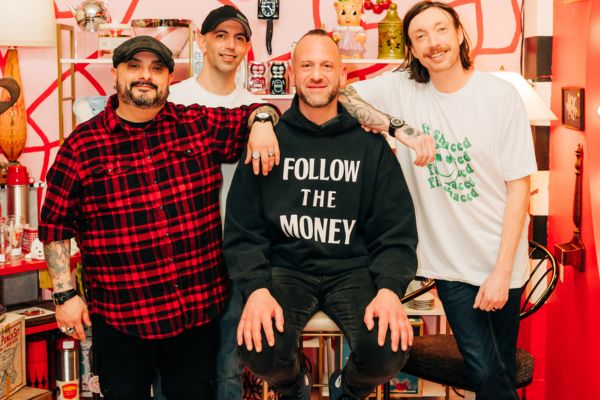
ME. wasn’t supposed to be a band.
After nearly a decade apart, former Taking Back Sunday founding members Mark O’Connell and Eddie Reyes started writing together again with no intention of forming one. They had already experienced what happens when something you built stops feeling like your own.
The distance between them hadn’t come from one moment, but from years of miscommunication and assumptions. When Eddie exited the band in 2018 under difficult circumstances, he believed Mark had known more than he actually did, when in reality, Mark had been kept in the dark. For years, each of them carried a version of the story the other didn’t even know existed. It wasn’t until much later that they began to understand what really happened, and how closely their experiences mirrored each other.
The first real step back came from an unexpected place. Eddie’s son, Jonas, encouraged Mark to reach out to his dad. After a brief reconnection, Casey Carter, a lifelong Taking Back Sunday fan turned friend who had stepped away from the music world years earlier to raise her daughter, helped turn that first step into something that actually moved. Casey ultimately got Mark and Eddie back in the same room for the first time in nearly a decade and helped keep the fragile reunion moving forward when old tensions and outside influences threatened to derail it.
It wasn’t easy. At first, they struggled just to exist in the same space together. But slowly, through writing, the tension started to give way to something else.
They didn’t take that lightly. They had both lived through what happens when something meaningful gets pulled apart, and neither of them were interested in repeating it. This time, they protected the process. They kept it close, kept it honest, and kept it theirs.
So they set rules: no frontman, no hierarchy. Just ten songs and ten different vocalists.
For the first time in years, everything was theirs. Mark and Eddie wrote and recorded all ten instrumentals themselves, building the songs from the ground up with a level of creative control they hadn’t experienced since the early days of Tell All Your Friends.
Those instrumentals became something more than just songs. They were a way of working through everything that hadn’t been said, tension, confusion, frustration, and loss, without having to explain it out loud. There was something familiar in them too. Not in a nostalgic, looking-back kind of way, but in the feeling. The kind of sound that pulls you back to a version of yourself you remember, even when everything around you has changed.
To kick off the project, they launched an open casting call. They released one instrumental publicly and invited singers to submit vocals. While some strong submissions came in, nothing quite landed.
Then something unexpected happened.
While scrolling through Instagram, Casey came across Chicago musician Mike Jansen, someone she had known years earlier. Remembering both his voice and who he was as a person, she reached out to see if he might be interested in contributing to the project, not realizing he had already found the casting call himself and started working on a submission.
When he finally sent it through, the reaction was immediate.
Casey played it for Mark. After listening, he looked at her and asked,
“Did you tell him everything?”
She hadn’t.
But somehow, the lyrics landed exactly where it hurt. They spoke directly to experiences Jansen had no way of knowing, reflecting years of history, tension, and things left unsaid.
Jansen was flown out to meet the guys at Applehead Recording in Woodstock, NY. He began by recording the track he had submitted, which ultimately became “Special.” But it was another song, “Grown Man,” that changed everything. When he played the demo he had prepared, the shift in the room was immediate. It was one of those rare moments where everyone hears it at once.
They didn’t change it. The version on the record is almost identical to that first demo.
Sometimes the right voice doesn’t just sing the songs.
It says the things no one else could.
At one point, Casey mentioned the band might want him to stay another night or two. Jansen didn’t hesitate.
“That’s cool,” he said. “I didn’t pack for a night. I packed for two weeks.”
He felt it before anyone said it out loud.
Like he trusted something they were still learning how to believe in again.
The instrumentals themselves had been written in a very different headspace. For Mark and Eddie, they were a way of working through years of tension, confusion, and unresolved pain. The music was raw, unfiltered, and deeply personal.
When Jansen stepped in, he brought something entirely different. As an outsider, he wasn’t carrying that same history. Instead, he layered his own perspective, his own lyrics, and his own story over what they had created.
That distance changed everything. It allowed the music to be heard differently, not as something stuck in the past, but as something evolving beyond it.
It gave them just enough space to look at it without being pulled under by it.
In that sense, Jansen didn’t just step into the project. He helped redefine it.
Letting him in wasn’t automatic. For Mark and Eddie, it meant confronting something deeper, not just whether the music worked, but whether they were willing to trust a frontman again after everything they had been through.
It wasn’t easy. But it was necessary.
Because starting over doesn’t mean forgetting. It means deciding it’s still worth trying again.
As producer Chris Bittner put it,
“When the universe gives you a gift like this, you don’t say, ‘No thank you. Maybe later.’”
Not long after, Neal Amiruddin stepped in on bass. Neal had been part of their lives since childhood, growing up alongside Mark and longtime friend Shaun Cooper in the same tight-knit group of kids who first bonded over music. When those relationships fractured in early 2024, Neal found himself on the outside alongside Mark. His return didn’t feel like adding a bassist so much as bringing a brother back into the fold.
The music that followed didn’t come from a comfortable place. Much of it was written during one of the most turbulent periods of the band members’ lives, surrounded by personal upheaval, lawsuits, and the kind of chaos that leaves no room to hide.
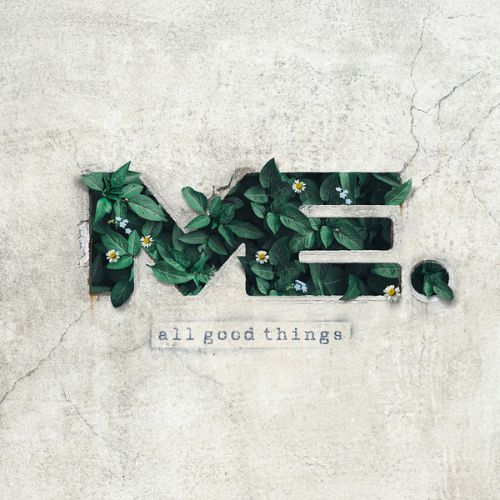
The result is ALL GOOD THINGS, a record built from fragments of the past but firmly rooted in the present. It carries echoes of where these musicians came from, but it isn’t interested in recreating it. Instead, the band leans into something more human: the messy, imperfect process of starting over. The part no one talks about. The part where you’re not sure it’s going to work, but you do it anyway.
For Mark and Eddie, it’s the first time in years that making music has felt fully theirs again.
For Mike, it became the moment where preparation met opportunity.
And for everyone involved, it’s proof that sometimes the most meaningful things come from finally seeing things clearly and choosing not to walk away, even when it would have been easier.
ME. isn’t a reunion. It’s a rebirth.